
Compare the 2025 and 2026 long-term breakpoints
Choose the tax year and filing status first; then compare the holding period and the applicable breakpoint. Everything else in this article depends on those two inputs.
Two things decide which column you read: the tax year in which the disposal falls, and your taxable income for that year. Not your proceeds, not your gross income. Taxable income is what lands on the return after deductions, and it is the number the long-term tables are indexed against.
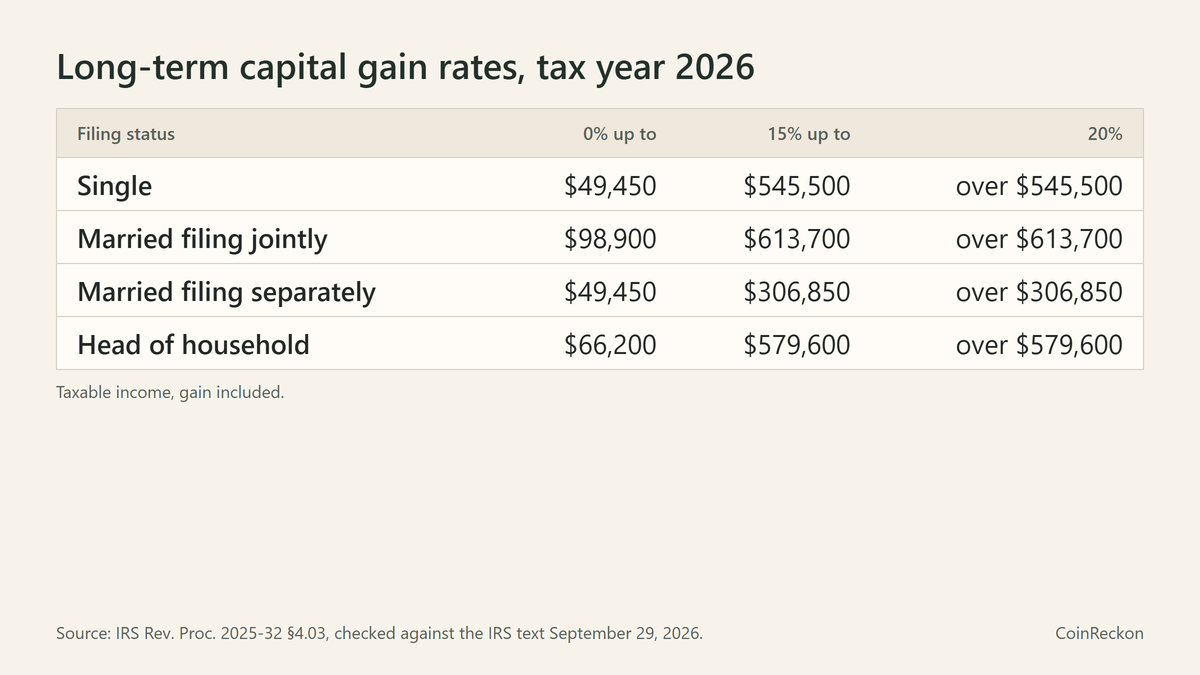
| Filing status | 2025: max taxable income at 0% | 2025: max at 15% | 2026: max taxable income at 0% | 2026: max at 15% |
|---|---|---|---|---|
| Single | $48,350 | $533,400 | $49,450 | $545,500 |
| Married filing jointly / qualifying surviving spouse | $96,700 | $600,050 | $98,900 | $613,700 |
| Married filing separately | $48,350 | $300,000 | $49,450 | $306,850 |
| Head of household | $64,750 | $566,700 | $66,200 | $579,600 |
The 15% band begins above the 0% ceiling in each column, and the 20% rate applies to taxable income above the 15% ceiling for your status. A garden-variety crypto sale from an investment holding runs through the 0/15/20% ladder. Publication 544 also lists 25% and 28% tiers, which attach to unrecaptured section 1250 gain and to collectibles, not to an ordinary crypto disposition.
The distinction underneath the whole table is short and old: one year or less held means a short-term gain taxed as ordinary income; more than one year means a long-term gain on the preferential ladder above.
Where do these numbers come from? The IRS publishes the inflation-adjusted figures each year in a Revenue Procedure - Rev. Proc.
2024-40 for tax year 2025, Rev. Proc. 2025-32 for tax year 2026 (current figure at the IRS).
What changes when you hold past the one-year mark?
Counting is the part people get wrong, and it costs real money. The holding period starts the day after you acquire the asset, and the day you dispose of it counts. Publication 550 states the rule, and it says plainly that a digital asset is treated as property, so the general property principles - including how you figure your holding period - apply to it.
A sale on the exact one-year anniversary date is short-term.
That conclusion is an application of the counting rule and the worked examples in Publications 550 and 544 rather than a sentence the IRS wrote about anniversaries: a June 17, 2024 purchase sold on June 17, 2025 is not long-term, while the June 19, 2025 sale is.
To cross into long-term territory you need a disposal on or after the day following the anniversary.
Here is the same idea built as a hypothetical, with every input labeled.
Annotated example (all inputs hypothetical)
| Input | Value |
|---|---|
| Purchase date | June 17, 2025 |
| Candidate sale date A | June 17, 2026 |
| Candidate sale date B | June 19, 2026 |
| Filing status | Single |
| Other taxable ordinary income | $60,000 |
| Net gain on the disposal | $10,000 |
| MAGI | $70,000 |
| Other gains, losses, special categories, return changes | None |
- Sale A, June 17, 2026: exactly one year after purchase, so the counting-rule inference puts it on the short-term side. The $10,000 sits inside the 22% ordinary band for a single filer at this income level: $10,000 × 22% = $2,200.
- Sale B, June 19, 2026: past one year, so long-term. Taxable income here is far below the $545,500 ceiling, so the rate is 15%: $10,000 × 15% = $1,500.
- Illustrative difference: $700 of federal tax, gain held constant on purpose.
That $700 is arithmetic, not a forecast. It exists only because I held the gain fixed at $10,000 across both dates to isolate the rate effect, and a real price two days later is a different number in either direction. Both gains stay inside their tiers in this setup, and MAGI of $70,000 is under every additional-tax threshold.
This is editorial arithmetic built from the rules above and the 2026 rates, not an IRS example and not a promised saving.
One more thing worth saying out loud, since the two get conflated: the arithmetic tells you what the rate difference is worth on a fixed gain. It says nothing about whether the asset will be worth holding for two more days.
Find the ordinary-income bracket for a short-term gain
Short-term net capital gain is taxed at the graduated ordinary rates, so a short-term crypto gain gets stacked with wages, self-employment income and everything else on the return. Seven rates apply to individuals: 10%, 12%, 22%, 24%, 32%, 35% and 37%. That structure was made permanent, so the rates themselves are the same in both years compared here; only the dollar bounds move.
| Filing status / tax year | 10% ceiling | 12% ceiling | 22% ceiling | 24% ceiling | 32% ceiling | 35% ceiling |
|---|---|---|---|---|---|---|
| Single, 2025 | $11,925 | $48,475 | $103,350 | $197,300 | $250,525 | $626,350 |
| Single, 2026 | $12,400 | $50,400 | $105,700 | $201,775 | $256,225 | $640,600 |
| Married filing jointly / qualifying surviving spouse, 2025 | $23,850 | $96,950 | $206,700 | $394,600 | $501,050 | $751,600 |
| Married filing jointly / qualifying surviving spouse, 2026 | $24,800 | $100,800 | $211,400 | $403,550 | $512,450 | $768,700 |
| Married filing separately, 2025 | $11,925 | $48,475 | $103,350 | $197,300 | $250,525 | $375,800 |
| Married filing separately, 2026 | $12,400 | $50,400 | $105,700 | $201,775 | $256,225 | $384,350 |
| Head of household, 2025 | $17,000 | $64,850 | $103,350 | $197,300 | $250,500 | $626,350 |
| Head of household, 2026 | $17,700 | $67,450 | $105,700 | $201,750 | $256,200 | $640,600 |
Each band starts above the preceding ceiling, and 37% applies to taxable income above the last bound in the row.
Head of household does not track single at the low end, and the 2026 head-of-household bounds of $201,750 and $256,200 sit a few hundred dollars away from the single-filer figures at the same rates - close enough that reading the wrong row looks plausible and still gives the wrong answer.
Graduated means graduated. Landing in the 24% bracket does not tax your income at 24%; it taxes the slice above the 22% ceiling at 24%. A gain can also straddle a boundary: if a single filer's 2026 taxable income is $100,000 before a $10,000 short-term gain, part of that gain is taxed at 22% up to $105,700 and the rest at 24%.
Two numbers people substitute for each other here: proceeds and taxable income. Proceeds are what the sale brought in, the gain is proceeds minus basis, and taxable income is the whole return after deductions. Only the last one picks your row.
For the mechanics of getting a disposal onto the return, carry a sale through Form 8949 and Schedule D.
Check whether the 3.8% NIIT adds another layer
There is a second federal layer, and it uses a different income measure than everything above. The Net Investment Income Tax is 3.8%, applied to the lesser of your net investment income or the amount by which your modified adjusted gross income exceeds the threshold for your filing status.
MAGI is not taxable income. Taxable income comes after deductions; MAGI is adjusted gross income with certain items added back, and it sits higher on the return. Someone whose deductions pull taxable income under a long-term breakpoint can still be over a NIIT threshold on MAGI.
The thresholds, in MAGI:
- Married filing jointly or qualifying surviving spouse: $250,000
- Married filing separately: $125,000
- Single or head of household: $200,000
Scenario card: high MAGI (hypothetical)
- Single filer, MAGI $210,000, net investment income $15,000.
- MAGI above the $200,000 threshold: $10,000.
- Lesser of net investment income ($15,000) and the threshold excess ($10,000): $10,000.
- NIIT: $10,000 × 3.8% = $380.
- Input to check: your MAGI for the disposal year, not your taxable income.
Note what the card does not do. It does not apply 3.8% to the full $210,000, and it does not apply 3.8% to the whole $15,000 of investment income automatically. The lesser-of rule is the whole mechanism.
These thresholds were set by statute and are not indexed for inflation - they have been the same since the tax took effect in 2013 and are identical for tax years 2025 and 2026. So while the bracket and breakpoint tables shift every year, the NIIT thresholds stay put, which means each year of inflation quietly pulls more filers over them.
Read the comparison against your own records
Before you compare any outcome, write down six inputs: the tax year of the disposal, your filing status for that year, an estimate of taxable income, an estimate of MAGI, the purchase date, and the candidate sale dates.
Those six pick every row in this article.
Scenario card: different disposal year A sale settling in 2026 rather than 2025 reads the 2026 tables. A single filer's 0% long-term ceiling moves from $48,350 to $49,450, and the 22% ordinary ceiling moves from $103,350 to $105,700. Input to check: which tax year the disposal actually falls in.
Scenario card: changed filing status A status change between years moves the whole row, not one number.
Married filing separately caps the 15% long-term band at $306,850 in 2026 while married filing jointly runs to $613,700. Input to check: the filing status you will actually use on that year's return.
Scenario card: anniversary sale Apply the counting rule before you look at any rate.
Day after acquisition starts the clock, disposal day counts, and the exact anniversary falls on the short-term side. Input to check: the acquisition date on the record for that specific lot, and whether the candidate sale date is at least one day past the anniversary.
Where the records go sideways, the rate lookup stalls before it starts. One season I worked through a transfer between two exchanges that arrived at the receiving platform with no history attached - no acquisition date, no basis, just a balance. Until that date was reconstructed from the sending side, no holding-period question about it could be answered at all, let alone a rate question.
A breakpoint lookup assumes you already know when you bought.
If the sale is part of a loss plan rather than a gain plan, review the rules before harvesting a loss first, and if a gain of this size might change your payments during the year, check when estimated tax may be due.
Sources
- IRS Revenue Procedure 2024-40, §§2.01 and 2.03 (TY2025 brackets and breakpoints): rp-24-40.pdf
- IRS Revenue Procedure 2025-32, §§2.01, 4.01 and 4.03 (rate structure and TY2026 tables): rp-25-32.pdf
- IRS Topic No. 409, Capital gains and losses (governing treatment): irs.gov/taxtopics/tc409
- IRS Publication 550 (2025), "Holding Period" and "Holding period and digital assets": irs.gov/publications/p550
- IRS Publication 544 (2025), "Long and Short Term" and "Capital Gains Tax Rates" (worked example and specialized-rate scope): irs.gov/publications/p544
- IRS Net Investment Income Tax (rate and lesser-of rule): irs.gov/individuals/net-investment-income-tax
- IRS NIIT Questions and Answers (filing-status thresholds): questions-and-answers-on-the-net-investment-income-tax
- IRS Estimated Tax FAQ (contextual payment pointer): irs.gov/faqs/estimated-tax
Decide what to calculate before choosing a sale date
Settle the dates and the income measures before you compare any two outcomes. That means: the acquisition date for the specific lot, the candidate disposal dates, the tax year each one falls in, your filing status, your taxable-income estimate, and your MAGI estimate. Guessing at any one of them makes the rate comparison decorative.
"How much will I owe on my crypto gains?" has a bounded answer at this stage, and the bound matters.
From the tables here you can get a planning estimate: the marginal rate the gain would face short-term, the preferential rate it would face long-term, and whether 3.8% sits on top of some or all of it.
What you cannot get is your bill. A return has deductions, other income, other dispositions, carryovers and credits in it, and all of those move the result.
Sell now or wait? Split the question in two, because only half of it is a tax question.
The tax half is arithmetic you can do today: hold the gain constant, run it at the short-term rate and at the long-term rate, and see what the difference is on your numbers - $700 in the hypothetical above, something else in yours.
The other half is about price and your own plan between now and the date the holding period clears, and no rate table speaks to that. CoinReckon does not tell you when to trade.
One case genuinely calls for outside help: a large gain sitting near several thresholds at once, where a long-term breakpoint, an ordinary-bracket boundary and a NIIT threshold are all within reach of the same transaction.
The interactions there are not a lookup, and qualified individual tax advice is worth the fee.
To run your own figures, calculate a crypto capital gain using the verified rates with the correct tax year, filing status and dates entered, then check when estimated tax may be due if the gain is large enough to change your payments during the year.
For the rest of the federal picture, browse the federal crypto filing guides.