
You sold once, and the question is what that sale adds to your federal tax bill.
The calculator below takes the figures from your own records and returns the incremental federal income tax, with the arithmetic it used.
It is an estimate of one disposal, not a return.
Use the calculator or checker
- Tax year: 2025 or 2026 (default 2026)
- Filing status: single, married filing jointly, married filing separately, head of household
- Taxable income before this sale
- Crypto asset and units sold
- Acquisition date and disposal date
- Gross proceeds, or the disposal-date USD fair market value
- Selling fees, and adjusted USD basis including acquisition costs
Leave basis blank and the tool returns a separately labeled zero-basis scenario, not a documented basis of zero. A transfer between your own custody locations is not a sale input here.
Estimate - not tax advice. The result uses only the data you enter, covers US federal income tax only, and is neither a filed return nor a final tax position.
What this tool does
One disposal, one jurisdiction, one number: the federal income tax your sale adds on top of the other taxable income you entered.
Filing software assembles every transaction, form and credit into a return; this is the quick check you run before that, the narrowest of the tools you can browse the crypto tax calculators for.
How the result is calculated or checked
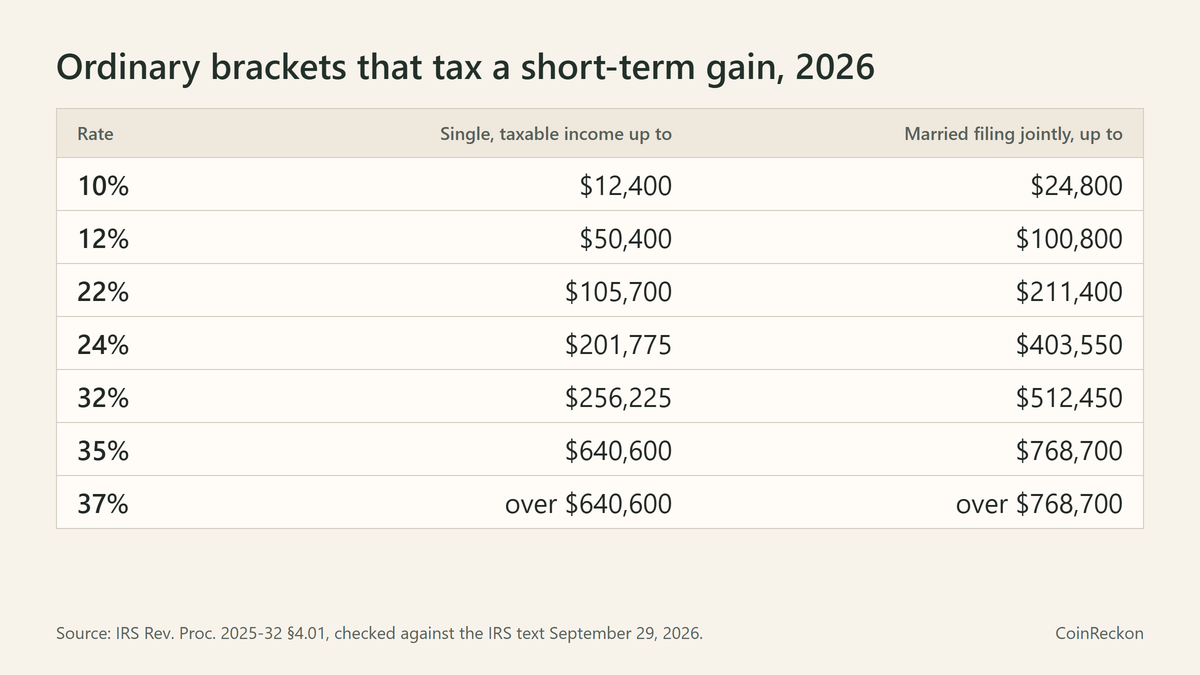
Gain or loss equals amount realized (sale proceeds less eligible selling costs) minus adjusted basis (acquisition cost including eligible acquisition fees). The holding period counts from the day after acquisition through the disposal day: one year or less is short term, more than one year is long term. Net short-term gain enters ordinary graduated income tax.
Eligible net long-term gain uses the applicable 0%, 15% or 20% capital-gain bands, stacked above your other taxable income, which is why the band depends on the income figure you entered (IRS Tax Topic 409).
The incremental figure comes from two calculations: tax on your entered income with this sale, minus tax on the same income without it.
Worked example
Our test file CR-2026-04 exercises the long-term path. Single filer, $78,000 of taxable income before the sale, 1.5 ETH acquired November 12, 2024 for $4,200 including acquisition fees, sold March 5, 2026 for $7,600 with $45 in selling fees. This is CoinReckon's illustrative example, not an IRS example.
| Step | Value |
|---|---|
| Gross proceeds | $7,600.00 |
| Less selling fees | -$45.00 |
| Net amount realized | $7,555.00 |
| Less adjusted basis | -$4,200.00 |
| Gain | $3,355.00 |
| Holding count | November 13, 2024 through March 5, 2026 |
| Holding category | Long term (more than one year) |
| Band applied | 15% long-term band, single filer, 2026 register row |
| Tax with sale minus tax without sale | $503.25 |
When we first ran this file with the basis cell empty, the same sale came back as a $7,555 gain under the zero-basis scenario, roughly $1,133 of estimated tax.
Read your result
The result panel names five things: gain or loss, the holding label, which brackets the gain touched, the incremental federal tax, and the tax year with the source badge for the rates used. Check the badge first - a 2025 sale has to run on 2025 rates.
Missing-basis decision card
| Your records show | The tool returns | Your next move |
|---|---|---|
| Adjusted basis documented with purchase records | Gain or loss from that basis | Match each figure to the source record, then proceed |
| Basis field empty | Zero-basis scenario, labeled separately | Locate the acquisition record before relying on any output |
IRS digital-asset recordkeeping expects transaction date and time, units, fair market value and basis. A blank basis field means the record is missing, not that the number is zero.
Rates, rules and source dates
The ordinary brackets and the long-term breakpoints both come from the annual IRS Revenue Procedure for the tax year, and the holding-period rule from Tax Topic 409.
Each rate carries its own verification date, printed beside the figure rather than taken from this page's date, because a figure correct on the day it was checked can be superseded later.
For a decisive threshold, read it off the Revenue Procedure for that year: Rev. Proc. 2024-40 for 2025, Rev. Proc. 2025-32 for 2026.
| Tax year | Filing statuses covered | Ordinary bands | Long-term breakpoints | Primary IRS document | Verified at |
|---|---|---|---|---|---|
| 2025 | All four | Seven graduated bands, register rows | 0% / 15% / 20% | Rev. Proc. 2024-40 §2.01 (ordinary), §2.03 (long term) | 2026-09-26, shown with each figure |
| 2026 | All four | Seven graduated bands, register rows | 0% / 15% / 20% | Rev. Proc. 2025-32 §4.01 (ordinary), §4.03 (long term) | Printed by the tool beside each 2026 figure |
A 2025 sale belongs to the 2025 return and a 2026 sale to the 2026 return; the calculator defaults to 2026, and its 2025 materials rest on the Schedule D and Form 8949 instructions.
For full band detail, check the capital gains rate.
Edge cases and limits
Sell at a loss and the tool shows that loss in isolation.
On a real return, realized losses net within the same holding-period category first, then against the other, and any remaining net loss offsets ordinary income only up to an annual cap, with the unused amount carried forward.
None of that happens here, so estimate how a loss may offset gains instead.
Two date traps: a same-day buy and sell is short term, and so is a sale on the anniversary date, because the count starts the day after acquisition.
Investment income at higher income levels can also attract the 3.8% net investment income tax, which applies above modified adjusted gross income of $200,000 (single or head of household), $250,000 (married filing jointly) or $125,000 (married filing separately), per IRS Topic No. 559. The tool flags a gain that takes your entered income past that line but does not compute the tax. Consequential amounts, thin records or a contested classification belong with a qualified tax professional, not with a widget.
What this tool cannot tell you
The output is only as good as what you typed, and the inputs are often the weak part: an unverified basis, a proceeds figure never matched to the exchange statement. The tool does not compute state tax, AMT, credits, loss carryovers, your exact NIIT, or the position you will actually file. It estimates one sale's federal effect; it does not find you savings, and it will not survive being quoted to the cent.
Common questions
Is my sale short-term if I sell on the anniversary date? Yes. The count runs from the day after acquisition, so the anniversary date still falls within one year.
Selling one day later flips the category, so check this boundary against the actual trade timestamps.
Why does my gain touch more than one tax bracket? Because long-term gain stacks above your other taxable income rather than being taxed on its own. A gain that starts inside one band can cross into the next, so part is taxed at one rate and part at another.
That is why a single flat percentage gives the wrong answer.
Can I use this number to file my return? No. It reflects only one disposal and leaves out return-level items such as other transactions, carryovers, credits and state tax. Use it to plan, then build the filed position from your full records.
Will a loss on this sale lower my regular income tax? It may, after the year's losses and gains are netted and subject to the annual cap on offsetting ordinary income. This tool shows the isolated loss only; the loss-planning tool handles the netting.
Related tools and guides
If your broker's proceeds or basis do not match what you entered, check the broker form against your records before you trust either figure. When the sale reaches the return, you will need to report the sale on Form 8949.
Match every amount and date you entered to a source record. Then take that reconciled set to the linked guide, or to a qualified professional, for the position you actually file.
Sources
- IRS Tax Topic 409, Capital Gains and Losses - holding period and capital-gain treatment. irs.gov/taxtopics/tc409, retrieved September 26, 2026.
- IRS Digital Assets - transaction records and basis. irs.gov/filing/digital-assets, retrieved September 26, 2026.
- IRS Rev. Proc. 2024-40 §§2.01 and 2.03 - tax year 2025 ordinary and long-term bands, carried in the rate register with its primary document link and verification date.
- IRS Rev. Proc. 2025-32 §§4.01 and 4.03 - tax year 2026 ordinary and long-term bands, carried in the rate register with its primary document link and verification date.
Estimate - not tax advice. For the position you file, report the sale on Form 8949.
Estimate the federal tax on one crypto sale
Your figures stay in this browser. Nothing is sent or saved.
Your estimate appears here.
Worst case if no basis can be documented
No basis was entered, so the purchase price is treated as zero here. That is a worst case, not your basis: documenting what you paid lowers the gain and the tax. Find the purchase record before relying on this figure.
Basis of 0 treats the whole proceeds as gain. If your statement showed a blank rather than a zero, the basis may be missing, not zero: tick "Basis unknown / missing" above, or see the Form 8949 walkthrough.
Sold on the anniversary date
| Rate | Part of the gain | Tax |
|---|---|---|
| Estimated federal tax on this sale | ||
Source: IRS Topic No. 559, Net investment income tax.
Not included: net investment income tax, AMT, state tax, credits and loss carryovers. The estimate treats the income you entered as ordinary income.
Holding period rule: IRS Topic No. 409, Capital gains and losses; Publication 550.
Estimate - not tax advice. Report the sale on Form 8949
Tax year 2026 rates: Rev. Proc. 2025-32 (IRS inflation adjustments for tax year 2026), figures as of September 29, 2026.