
This estimator books each staking reward event as ordinary income in the year you could first dispose of it, then shows the federal tax that income adds.
Use the staking income estimator
Enter tax year, filing status and other taxable income, then per reward event: units, USD value per unit at first free control, and when that control began. It runs in your browser; blank fields stay blank, because a zero is an answer.
Staking income estimator
- Tax year:
2025/2026 - Filing status:
single/married filing jointly/married filing separately/head of household - Other taxable income (USD):
_____ - Reward event 1: units
____| USD value per unit at first free control____| free-control date and time____ + add reward event[ Calculate estimate ]
Result lines: added ordinary income (USD) · estimated incremental federal tax (USD) · basis per reward event (USD)
Estimate - not tax advice. This federal-only result uses the numbers and assumptions you entered; it is not a filed return or final tax position and may omit relevant facts. A qualified professional can review consequential, disputed or unusual cases.
What this tool does
Scope: cash-method native proof-of-stake validation rewards, direct or through an exchange. Outputs: added ordinary income for the year, incremental federal tax and each reward event's basis. CoinReckon's basis and disposal tools do the rest.
How the result is calculated
- Staking income: units × USD fair market value at first free control, summed for events in the selected tax year.
- Incremental tax: tax on other taxable income plus staking income, minus tax on other taxable income alone, at the selected year's ordinary brackets for your filing status.
Under Rev. Rul. 2023-14 (2023), such rewards are ordinary gross income at fair market value when dominion and control begins, and that value becomes the units' cost basis.
The tax figure is a difference between two bracket computations, not a flat rate.
Worked example
Illustrative numbers, not an IRS example.
| Event | Credit date | First free-control date | Units | USD value per unit at free control | Recognized ordinary income | New basis |
|---|---|---|---|---|---|---|
| A | Dec 28, 2025 | Jan 6, 2026 | 40 | $3.15 | 40 × $3.15 = $126.00 | $126.00 ($3.15/unit) |
| B | Mar 2, 2026 | Mar 2, 2026 | 12 | $2.90 | 12 × $2.90 = $34.80 | $34.80 ($2.90/unit) |
| Tax year 2026 | 52 | $160.80 | $160.80 |
Event A, credited in December but locked until January, is 2026 income. For a single filer with $70,000 of other taxable income, both computations fall in the 2026 22% band ($50,400 to $105,700): $160.80 × 22% = $35.38 incremental tax. The $160.80 basis stays with the 52 units until sale.
Read your result
The added-income line joins your ordinary income for the year; the incremental-tax line is the gap between two computations, so it can look small or jump when rewards cross a band. Keep the per-event basis record: a later sale is a separate event measured from that value, so estimate the tax on a later sale then.
Estimate - not tax advice. This federal-only result uses the numbers and assumptions you entered; it is not a filed return or final tax position and may omit relevant facts. A qualified professional can review consequential, disputed or unusual cases.
Rates, rules and source dates
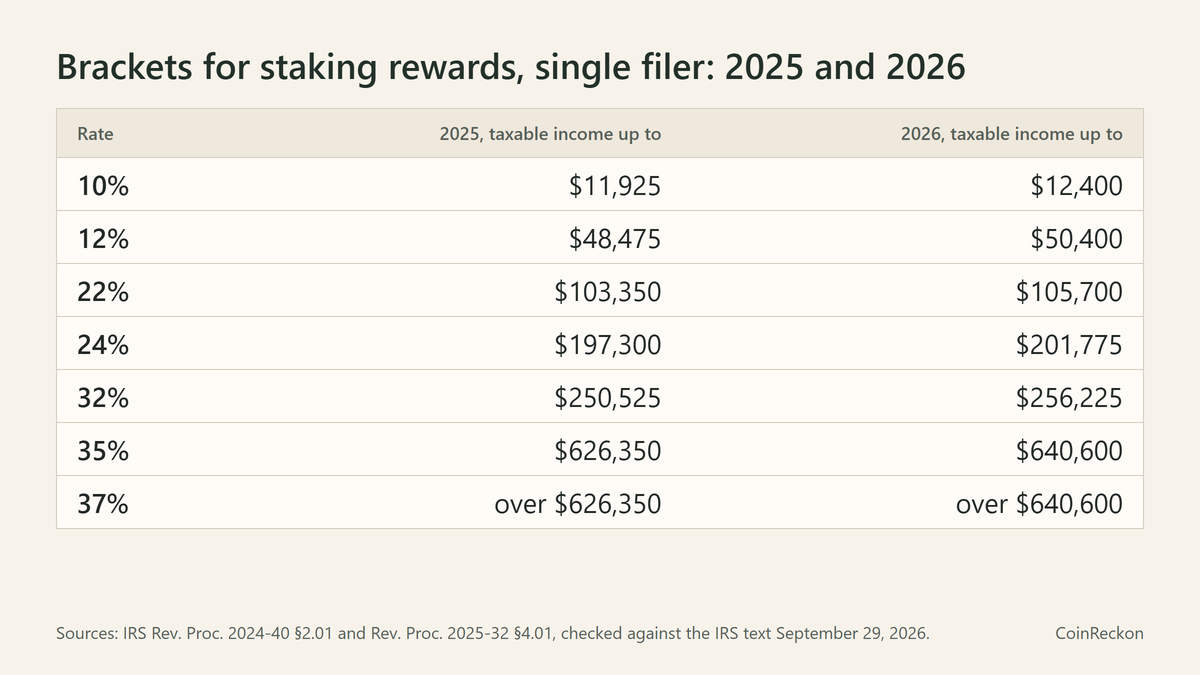
The ruling sets the recognition rule; the IRS annual inflation procedures set the brackets, which change every year (current figure at the IRS). Before you file, check your year against the Revenue Procedure section named in the table.
| Tax year | Filing status | 10% from | 12% from | 22% from | 24% from | 32% from | 35% from | 37% from | Primary source | Source date | Verified at |
|---|---|---|---|---|---|---|---|---|---|---|---|
| 2025 | Single | $0 | $11,925 | $48,475 | $103,350 | $197,300 | $250,525 | $626,350 | Rev. Proc. 2024-40 §2.01; IRC §1(j)(2)(A)-(E) | 2024 | 2026-09-26 |
| 2025 | Married filing jointly | $0 | $23,850 | $96,950 | $206,700 | $394,600 | $501,050 | $751,600 | Rev. Proc. 2024-40 §2.01; IRC §1(j)(2)(A)-(E) | 2024 | 2026-09-26 |
| 2025 | Head of household | $0 | $17,000 | $64,850 | $103,350 | $197,300 | $250,500 | $626,350 | Rev. Proc. 2024-40 §2.01; IRC §1(j)(2)(A)-(E) | 2024 | 2026-09-26 |
| 2025 | Married filing separately | $0 | $11,925 | $48,475 | $103,350 | $197,300 | $250,525 | $375,800 | Rev. Proc. 2024-40 §2.01; IRC §1(j)(2)(A)-(E) | 2024 | 2026-09-26 |
| 2026 | Single | $0 | $12,400 | $50,400 | $105,700 | $201,775 | $256,225 | $640,600 | Rev. Proc. 2025-32 §4.01; IRC §1(j)(2)(A)-(E) | 2025 | 2026-09-26 |
| 2026 | Married filing jointly | $0 | $24,800 | $100,800 | $211,400 | $403,550 | $512,450 | $768,700 | Rev. Proc. 2025-32 §4.01; IRC §1(j)(2)(A)-(E) | 2025 | 2026-09-26 |
| 2026 | Head of household | $0 | $17,700 | $67,450 | $105,700 | $201,750 | $256,200 | $640,600 | Rev. Proc. 2025-32 §4.01; IRC §1(j)(2)(A)-(E) | 2025 | 2026-09-26 |
| 2026 | Married filing separately | $0 | $12,400 | $50,400 | $105,700 | $201,775 | $256,225 | $384,350 | Rev. Proc. 2025-32 §4.01; IRC §1(j)(2)(A)-(E) | 2025 | 2026-09-26 |
Edge cases and limits
Our test files break most often on a December credit with a January unlock: under the ruling, a reward credited while disposal is prohibited is income in the later year when disposal becomes possible, the year of first dominion and control.
A genuine unbonding prohibition can move that date; a limit only on transfers to an external wallet does not settle it. In Paschall, the Tax Court held rewards includable on receipt where the taxpayer could still sell despite such a limit, and later Cardano-related case law applied constructive receipt the same way.
The ruling does not reach accrual-method treatment, gas or transaction fees, or rules it does not cite, so claim and unstaking fees need their own treatment.
Nor does it squarely address rebasing or exchange-rate-accrual designs; with no IRS rule or safe harbor, and practitioners split on whether a liquid-staking deposit is a disposal, the tool lets you mark such a position, leaves it out of the total and says why instead of estimating a figure.
Free-control checklist, one pass per reward event
- Could the units be sold or otherwise disposed of on the credit date? If yes, use that date and time.
- Was a real disposal prohibition, such as a lockup or unbonding period, in force? Use the date it lifted.
- Is the only limit on transfers to an external wallet? That alone does not decide it if you could sell where the units sat.
- Is this a discrete native reward, or a rebasing or liquid-staking balance? The tool gives the second no figure.
- Are units, timestamp, USD value and any claim or unstaking fee on record?
The checklist guides your input; it does not decide your legal fact pattern.
What this tool cannot tell you
It cannot read your lockup terms to find your free-control date, or settle liquid-staking or rebasing treatment, which no IRS rule does. It cannot see unentered events, state or local tax or the rest of your return, and is neither IRS-approved nor a guarantee of tax saved. Take consequential amounts, disputed positions or record gaps to a qualified professional.
Common questions
If my rewards were credited in December but locked until January, which year do I enter? January's year, when disposal first became possible and dominion and control began.
Can I use this estimate if my staking token rebases every day? Only with an assumption you choose: no IRS rule or safe harbor covers rebasing designs, so the tool picks no default and labels the result with your scenario.
What record should I keep for a later sale of these rewards? Per event: units, USD value per unit at first free control, timestamp and the resulting basis. When you sell, estimate the tax on a later sale.
Why is the tax estimate different from my staking income total? It is tax with the rewards minus tax without them. Filing status and other income decide which bands the rewards fall into, so the same $500 of rewards can cost 12% or 32%.
Related tools and guides
Start from the hub: browse the crypto tax calculators.
For purchase lots beside these units, compare your purchase lots; for the full recognition rule, check when staking rewards become income.
Disposal has its own tool because the holding period affects the rate.
Save the event ledger and source records now, while retrievable, and use the later-sale tool only when those units are disposed of.
Sources
- IRS, Rev. Rul. 2023-14 - holding and example on cash-method native proof-of-stake rewards, dominion and control, and basis: rr-23-14.pdf (retrieved September 26, 2026).
- IRS, Rev. Proc. 2024-40 §2.01, with IRC §1(j)(2)(A)-(E) - tax year 2025 ordinary rate brackets.
- IRS, Rev. Proc. 2025-32 §4.01, with IRC §1(j)(2)(A)-(E) - tax year 2026 ordinary rate brackets.
- BDO, practitioner interpretation of the ruling's scope, including liquid staking: IRS clarifies when cryptocurrency staking rewards are included in taxable income (research state 2026), read alongside the contrary practitioner positions noted above.
Estimate the federal tax on your staking rewards
Your figures stay in this browser. Nothing is sent or saved.
For cash-method native proof-of-stake rewards, received directly or through an exchange. Each reward counts as ordinary income in the year you could first sell, exchange or otherwise dispose of it, at its USD value at that moment. Estimate - not tax advice; federal income tax only.
Your estimate appears here.
| Rate | Part of the staking income | Tax |
|---|---|---|
| Estimated federal tax on the staking income | ||
| Event | First free control | Units × USD per unit | Income | New basis |
|---|
The value counted for each reward becomes the cost basis of those units. A later sale or swap is a separate event measured from that basis: estimate the tax on a later sale.
Not included: state or local tax, claim, gas or unstaking fees, accrual-method treatment and any later sale of the units. Liquid-staking and rebasing tokens are not covered by Rev. Rul. 2023-14, so the tool gives them no figure.
Estimate - not tax advice. Check when staking rewards become income
This federal-only result uses the numbers and assumptions you entered; it is not a filed return or final tax position and may omit relevant facts. A qualified professional can review consequential, disputed or unusual cases.
Tax year 2026 rates: Rev. Proc. 2025-32 (IRS inflation adjustments for tax year 2026), figures as of September 29, 2026. Recognition rule: Rev. Rul. 2023-14, as of September 26, 2026.