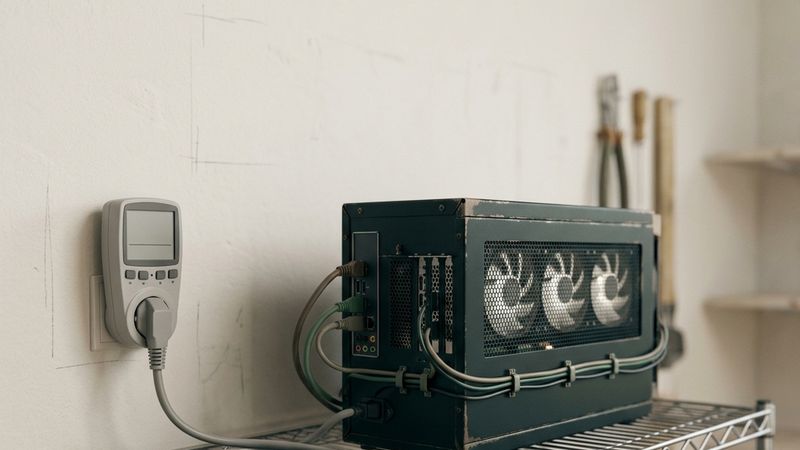
Two home miners can take in the same $4,000 of pool payouts and still file on different schedules, owe different amounts of tax, and treat their power bills in opposite ways.
Rig count does not settle it. Dollar volume does not settle it either.
What settles it is how the activity is run and what your records can show about that, which is why this page hands you an evidence checklist and a consequence map instead of a verdict.
Hobby or business: what changes for your mining taxes?
Start with the part that does not move. Under IRS Notice 2014-21, Q8, the fair market value of successfully mined virtual currency is gross income on receipt. That holds for a single GPU in a spare bedroom and for a rack in a rented unit.
Q9 adds the other half: when a nonemployee mines as a trade or business, the resulting net self-employment earnings are subject to self-employment tax. So classification does not switch your mining income on or off. It changes where that income is reported, whether your electricity and hardware costs can be treated as business expenses at all, and whether a second layer of tax sits on top of ordinary income tax.
The expense question is usually what brings readers to this page, and it is the one that depends most directly on classification.
How hobby and business mining differ
| Issue | Hobby mining | Trade-or-business mining | Record to keep |
|---|---|---|---|
| Receipt income | Fair market value at receipt is gross income (Notice 2014-21, Q8) | Same rule, same timing | Date, quantity, and USD value of each payout, with the price source |
| Individual's reporting route | Non-sale digital-asset income not otherwise reported goes on Schedule 1, line 8v for tax year 2025 | Schedule C for business mining income | Payout totals reconciled to the schedule you filed |
| Electricity and hardware costs | Hobby expenses are not deductible against hobby income under current federal rules | Costs are deductible only as ordinary and necessary business expenses, following the classification | Utility bills, meter or sub-meter readings, invoices, and a mixed-use log |
| Self-employment tax | No self-employment tax on hobby income | Net earnings can be subject to self-employment tax (Notice 2014-21, Q9) | Net profit computation and its supporting expense records |
| Payer-issued forms | A qualifying payment may still generate an information return | Same: the form follows the payment, not the label you use | Every form received, plus your own records where no form arrives |
Work through the IRS factors with your own records
The classification test is qualitative. IRS guidance on separating a hobby from a business works through nine facts-and-circumstances factors, and no single one of them decides whether mining is conducted for profit. That cuts both ways: a spreadsheet full of receipts does not make you a business on its own, and mining part-time from a home office does not make you a hobbyist on its own.
Three assumptions send readers wrong. The first is that occasional activity settles the question, when intermittent operation is only one input among the nine. The second is that mining from home cannot be a trade or business.
The third is the one we see most often in reader mail: two miners report identical income, so they assume they must file identically, when their recordkeeping, profit history, and reliance on the income can differ completely.
Picture a miner who reports payouts as hobby income for three years purely because the monthly total looked small, then wants the electricity back as a deduction in the fourth. Nothing in the factor list supports a size-based shortcut in either direction, and the evidence trail for those earlier years is now thin. Fill the checklist in while the activity is running, not in April.
Write your own facts in the third column. Print it, or keep it beside the payout log.
Nine-factor evidence checklist
| Factor | Evidence prompt | Your facts |
|---|---|---|
| Businesslike manner and complete records | Separate account, payout ledger, mixed-use electricity and equipment records, receipts filed by year | |
| Expertise of the taxpayer or advisers | Pool configuration notes, hardware research, any paid advice and when you got it | |
| Time and effort spent | Activity log: uptime monitoring, maintenance hours, firmware and rig changes by date | |
| Expected appreciation of activity assets | Notes on why you hold hardware or mined coins, and what you expected to happen | |
| Success in similar or dissimilar activities | Prior ventures you ran, profitable or not, with dates | |
| History of income or losses | Year-by-year net result since you started, including startup years | |
| Amount of occasional profits | Size and timing of profitable months against total invested capital | |
| Financial status of the taxpayer | Whether you depend on mining income or it supplements other earnings | |
| Personal pleasure or recreation | Honest note on the hobbyist element: tinkering, gaming use of the same GPU, community involvement |
Can you deduct electricity and hardware costs?
Power is the running cost that decides whether small-scale mining clears anything at all, so the deduction question is fair. The answer follows the classification, not the purchase. A trade-or-business miner deducts ordinary and necessary business expenses against mining income.
Hobby income stays ordinary income with no offsetting hobby-expense deduction under current federal rules, which is the trap: the receipts keep arriving, the taxable amount stands, and the power bill does nothing for the return.
Mixed use is where home mining gets messy. The same wall circuit runs the dryer, and the same GPU that hashed overnight plays games on Saturday.
Collect evidence rather than a conclusion: monthly utility statements for the full period, any sub-meter or smart-plug readings tied to the rigs, hardware invoices with dates and serial numbers, and a written note of how personal and mining use split over time.
Those records are what any allocation would later have to rest on. How hardware cost gets recovered over time, and what an acceptable allocation looks like, are questions for a preparer working from your documents.
How self-employment tax changes the business calculation
Business treatment is not a one-way win, and this is the line item that surprises people. For 2025 and 2026, self-employment tax is generally 15.3% in total: 12.4% Social Security up to the annual wage base, plus 2.9% Medicare with no wage-base cap. The 2.9% sits inside the 15.3%, not on top of it.
The base matters as much as the rate. Self-employment tax applies to generally 92.35% of net self-employment profit, so it runs on what is left after deductible expenses, not on the gross value of your payouts. A separate 0.9% Additional Medicare Tax can apply above filing-status thresholds.
Both the wage base and those thresholds are set year by year, and the Additional Medicare thresholds also depend on how you file, so pull the figures for your tax year rather than carrying last year's numbers forward.
Ordinary income tax is a separate calculation on the same income. A business miner runs both.
A hobby miner reports the receipt income and owes income tax on it without the self-employment layer, which is the one real tax advantage of hobby status and the reason the deduction side has to be weighed against it.
Record mined coins when received, and keep pool questions separate
Value at receipt does two jobs. Notice 2014-21, Q8 puts the fair market value of mined units into gross income on the date you receive them, and that same value becomes your basis in those units. Sell later and you have a separate capital gain or loss measured against that basis, which is how a coin can generate income in one year and a loss in the next.
A second common slip is worth naming: a miner records the receipt value correctly for income, then later imports a sale into tax software with a zero cost basis, and pays twice on the same coins. Keep the receipt value in the basis record, not only in the income total.
Different reward types have their own timing arguments, so if you also earn validation rewards, compare staking reward timing rather than assuming one rule covers both.
If mined coins are later given away instead of sold, see the rules before gifting mined coins before the transfer, because the basis record you built at receipt is what carries forward.
Unpaid pool balances are the open case. A balance that has accrued but has not been paid out raises a genuine question about which moment governs, and Notice 2014-21 sets no pool-specific timing rule.
Build the file instead of guessing: the pool's balance history with timestamps, the written payout and withdrawal conditions in force at the time, minimum-threshold and lockup terms, the record of the payout actually hitting your wallet, and the price source you used for valuation.
That packet is what a qualified professional needs to reach a defensible position.
Match the reporting route to the payment and tax year
Two different things get confused here: where you report, and what a payer sends you. Your route follows your classification. For tax year 2025, non-sale digital-asset income not otherwise reported goes on Schedule 1, line 8v under the Form 1040 instructions for that year.
Business mining income goes on Schedule C. Check the current-year instructions before reusing a line number.
The payer side runs on its own thresholds.
Qualifying Form 1099-MISC payments are generally reportable at $600 or more for tax year 2025, and at $2,000 or more beginning tax year 2026 (current figure at the IRS), following legislation enacted in 2025, with inflation adjustment in $100 increments beginning 2027.
None of that is a tax-free allowance. It is a payer filing threshold, and your income obligation does not depend on whether a form shows up.
Form designation deserves care.
Notice 2014-21, Q13 described $600 or more of business payments to an independent contractor as reportable on Form 1099-MISC, which was the 2014 wording; current nonemployee-compensation reporting uses Form 1099-NEC.
Form 1099-DA covers broker sales and dispositions and excludes reward-type receipt income, so it will not document your mined payouts. Some pools issue a miscellaneous-income return, some issue nothing, and the form you receive follows the payment rather than your hobby or business label.
Choose your next step from the evidence you have
Documentation is what you control. Not the audit odds, not what a pool decides to file. If a prior year's receipts were omitted or misreported, an amended return is the route, and a complete receipt and classification record is what makes that correction straightforward.
Assemble three files and stop worrying about the rest: your classification evidence, your receipt and basis record, and whatever forms arrived alongside your own payout data.
Preparation decision tree
1. Does every payout have a dated receipt record?
- Yes, with date, quantity, USD value, and price source: move to step 2.
- No, part of the balance sat unpaid in the pool: save the balance history, the payout and access conditions with their dates, the receipt record, and your valuation source, then take that file to a professional for the timing call.
2. Can you document how the activity is run?
- Yes, the nine-factor checklist is filled in with evidence: prepare the matching route, Schedule C for business or the line for non-sale income in your filing year.
- Genuinely ambiguous: bring the completed checklist and expense records to a qualified professional for judgment, not a size-based guess.
3. Did a form arrive?
- Yes: reconcile it against your own payout log and report from the reconciled totals.
- No: report from your records. Keep both files either way.
Complete the mining evidence checklist, save the receipt values and matching records, and use the digital-asset tax guides for your next filing question. Next: find the digital-asset tax guides.
Sources
- IRS Notice 2014-21, Q8, Q9, Q10 and historical Q13: mining receipt income, business mining, independent-contractor wording. irs.gov 2014 notice; background modified 2023.
- IRS, "Know the difference between a hobby and a business," FS-2022-38: qualitative classification framework. irs.gov October 2022 edition.
- IRS General Instructions for Certain Information Returns, Publication 1099: payer thresholds and form scope. irs.gov as of 2025-2026; legislation effective for 2026 payments.
- IRS Instructions for Form 1099-DA: exclusion of reward payments from broker-sale reporting. irs.gov 2026 instructions.
- IRS Instructions for Form 1040, Schedule 1 line 8v: digital-asset income not otherwise reported. irs.gov tax year 2025.